

The audit trail
BuiltAdmin > Audit (with audit:read:admin, so administrators and owners only) is the read-only audit trail:
every privileged action and every sign-in, newest first, each with when it happened, who did it, the action,
and the resource. An action taken while impersonating shows the real administrator as the actor, with an
as <account> tag naming the user whose identity they assumed (for example admin as bob), so
accountability lands on the human who acted and impersonation never hides them. A read-only user (a viewer) does not
see this page: the audit trail is admin-level information, so a plain “read everything” grant does not open it.
Failed sign-ins on a real account show as login failed (and a sign-in to a disabled account as login
denied), so you can spot a brute-force attempt; attempts on usernames that do not exist are not recorded.
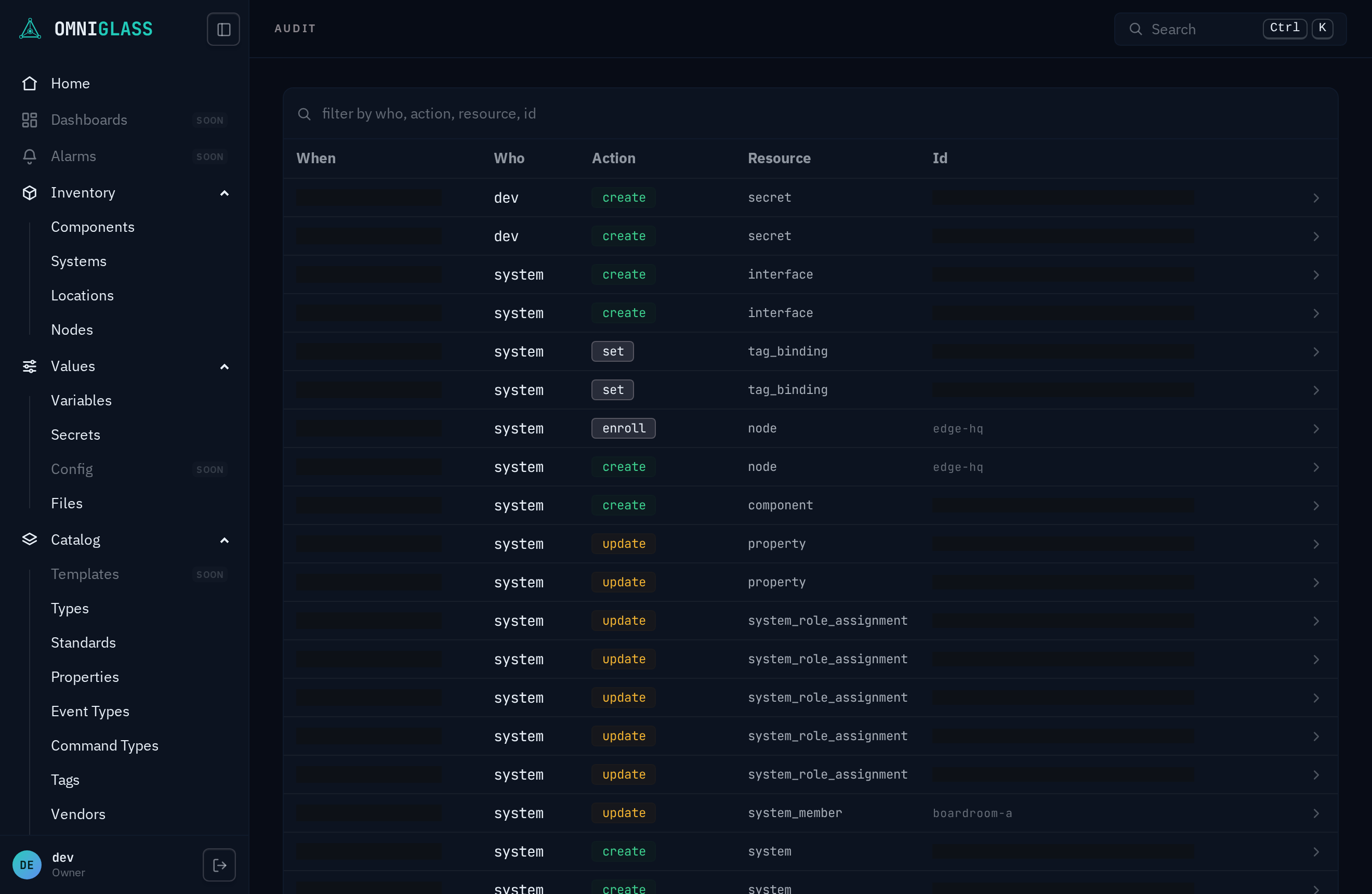
The page uses the same faceted search as the fleet lists: filter by who, action, resource,
id, channel, client, or agent (type a term for a quick actor search, or action:login to pin a facet), and combine chips to narrow.
Filtering runs over the rows already loaded; Load older pages further back in time, so a search that comes
up short is a cue to load older and look deeper. The rows scroll inside the list’s card, so the count and
Load older stay at its foot however many pages you have loaded.
The Id column shows the resource’s name (a user’s username), resolved from the row’s own
change images; hovering it reveals the stable uuid the trail actually stores, which is what keeps a row
attributable after a rename. resource_id is always the resource’s primary key, so a row whose images
carry no name (an older catalog delete) falls back to that raw uuid.
Pick a row to open its detail drawer: who acted (and, for an impersonated action, who was behind it), when, and the field-level before/after diff of the change itself. Changed fields highlight both sides, an added field only its After, a removed one only its Before, and unchanged fields dim. A create shows only an After column and a delete only a Before. A value that is JSON (an endpoint’s params and inputs, a driver’s spec) reads as indented JSON, and a long value wraps inside its own column, so both sides of a change stay on screen however long either is. Rows written before that shipped carried those JSON columns as base64 and still read that way: the trail keeps each row as it was written. Catalog mutations record the full row on both sides (an update carries the row as it stood and as it became, a delete the whole row it removed); rows written before that shipped carried only an id, so an old row can still read one-sided. Auth events (sign-ins, password changes) record no row images at all, and the drawer says so. Sealed material never appears: a secret’s audit row carries its metadata only, and password changes record that the credential changed, never a value.
An action an AI agent took through the MCP server is the user’s own row, and the
trail also records how it arrived. The Channel column marks such a row with an mcp pill and, under
it, the client the agent declared about itself (claude-code/2.1.0); a direct API call carries no pill.
An agent acting on its own token adds an agent <name> tag beside the person it acted for in Who:
the person is accountable, the agent is what acted. Filter with channel:mcp (or channel:direct for
everything that did not come through an agent’s tool call), client:claude, or agent:<name>. The
drawer’s Channel entry carries an info tip on what the channel proves and what it does not: the
server stamps it, so no caller can claim one, but it says how a call arrived, not what held the token, so
a script holding a person’s own token still reads as direct. The Client entry reads “as the agent
reported it” because the client is the agent’s own claim, recorded as asserted.
The same filters are on the API: GET /audit-log?channel=mcp&client=claude (and
omniglass audit-log list --channel mcp --client claude) returns "channel": "mcp" and the client
on such a row, and neither on a direct call. Minting
and revoking an API token each write a row too (resource credential), naming the token by its prefix
and description, never its secret.
The model behind the trail, what is recorded and the dual-actor rule for impersonation, is identity and access and audit.